

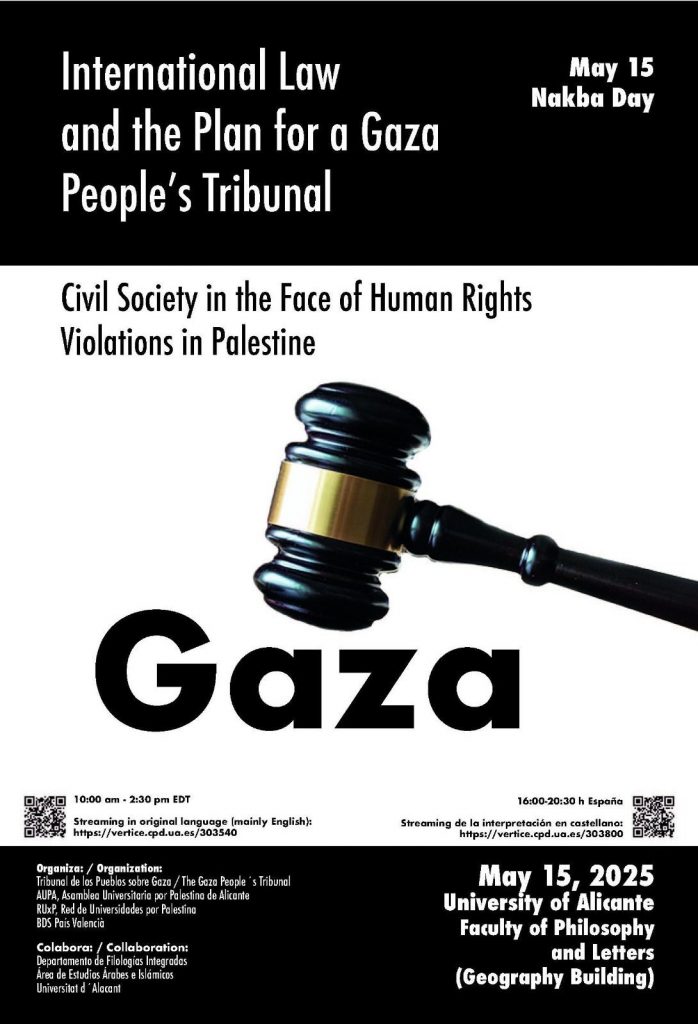
On Nakba Day, the University of Alicante hosted a special meeting of the Gaza Tribunal’s International Law Chamber (Chamber 1) under the title “The Gaza Tribunal: International Civil Society in the Face of Violations of International and Human Rights Law in Palestine.”
The event brought together members of Gaza Tribunal Chamber 1 to discuss international law and human rights violations committed in Gaza, within the scope of their respective fields of expertise.
Seeking Justice for Gaza under International Law
The meeting opened with welcoming remarks by Professor Pamela Stoll (University of Alicante).
Following her introduction, Professor Susan Akram (Boston University – Gaza Tribunal Chamber 1 Member) presented an overview of the Gaza Tribunal’s establishment, objectives, and methodology. She emphasized that when formal mechanisms of international justice fail, civil society must step forward—an idea central to the concept of a people’s tribunal.
Professor John Quigley (Ohio State University – Gaza Tribunal Chamber 1 Member) introduced the background reports on genocide, apartheid, and the ongoing Nakba, highlighting how the violations in Palestine stand in direct breach of fundamental norms of international law.
Professor Michael Lynk (Western University – Gaza Tribunal Chamber 1 Member) examined occupation and annexation through the lens of the International Court of Justice’s advisory opinions.
Professor Munir Nuseibah (Al-Quds University – Gaza Tribunal Chamber 1 Member) addressed the Palestinian people’s right to self-determination and legitimate resistance under international law.
Professor John Reynolds (Maynooth University – Gaza Tribunal Chamber 1 Member) discussed attacks on educational institutions, describing them as part of a broader pattern of cultural erasure that may constitute crimes against humanity.
Genocidal Intent, Blockade, and Civilian Protection Discussed
In the second session, Professor William Schabas (Middlesex University – Gaza Tribunal Chamber 1 Member) presented the Gaza Tribunal’s findings on manifestations of genocidal intent. Schabas underscored that the international community’s silence reflects political calculations overriding legal obligations.
Professor Maryam Jamshidi (University of Colorado – Gaza Tribunal Chamber 1 Member) discussed the erosion of civilian protections under international humanitarian law.
Sahar Francis (Addameer Prisoner Support Association – Gaza Tribunal Contributor) reported on arbitrary detention, torture, and hostage-taking practices.
Farah Imad (Arab Group for the Protection of Nature – Gaza Tribunal Contributor) analyzed the humanitarian consequences of the blockade, starvation policies, and the denial of the right to food in Gaza.
A Call for Justice from International Civil Society
The event concluded with reflections and closing remarks by members of the Red Universitaria por Palestina (RUxP).
Participants emphasized that the Gaza Tribunal represents a vital initiative by international civil society to document the violations in Palestine and to keep the pursuit of justice alive where formal mechanisms have failed.
The program was hosted by the Faculty of Philosophy and Letters of the University of Alicante, in collaboration with the Tribunal de los Pueblos sobre Gaza, the Asamblea Universitaria por Palestina de Alicante, the Red de Universidades por Palestina, and BDS País Valencià.